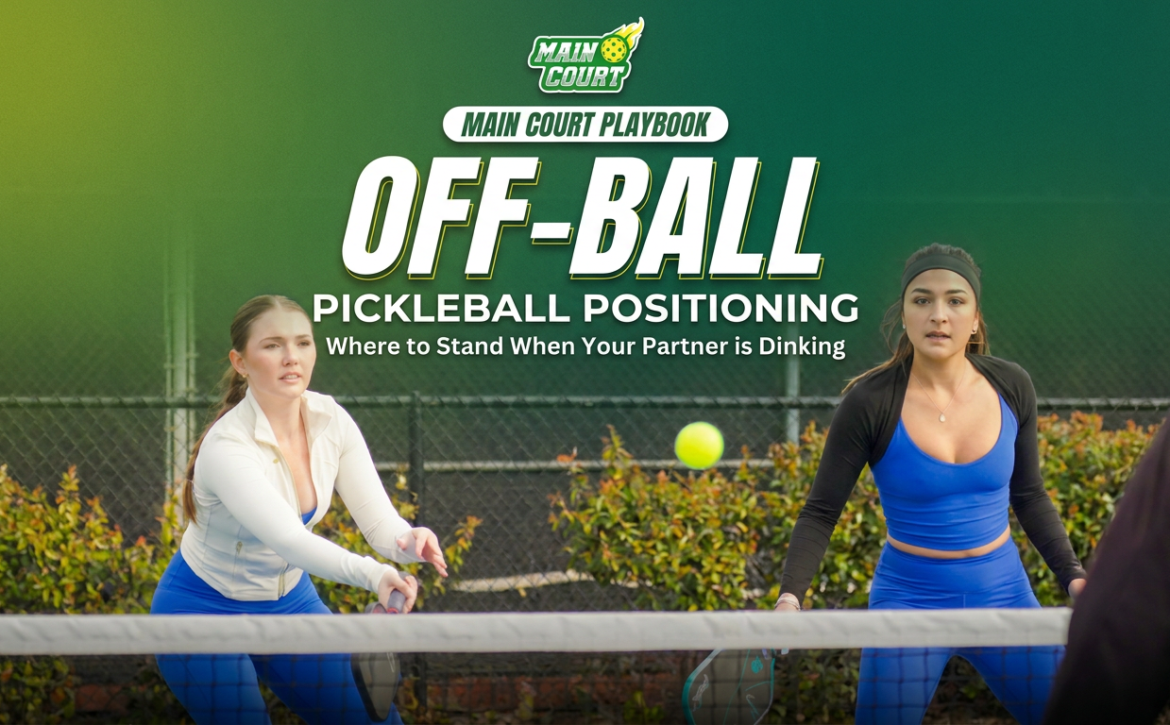
Off-Ball Pickleball: Where to Stand During Dinking

Main Court Playbook · Net Game Series
When your partner is dinking at the kitchen line, what are you doing? Most recreational players either crowd their partner, drift too wide, or just watch the rally hoping nothing comes their way. That's leaving points on the table. The off-ball player has a specific job — and once you understand it, your team's court coverage goes from reactive to coordinated.
The two roles of the off-ball player
Your off-ball pickleball positioning switches between two modes depending on where your partner is on the court. When your partner is dinking wide crosscourt, you become the pressure player — positioned about one step from the middle, covering the seam and ready to attack. When your partner moves to the middle, you shift into a defensive wall — slightly back, focused on reach and countering anything redirected your way. The mistake most players make is staying in one fixed position regardless of where their partner moves. Your positioning must be dynamic, not static.
Never crowd your partner
This is the most common off-ball positioning mistake we see across all skill levels in our community. When you drift too close to your partner, you double-cover one side of the court and leave a massive gap on the other. Your partner doesn't need help covering their zone — they need you covering yours.
Maintain enough separation that you can each cover your side independently while together closing the middle seam. Adjust your position dynamically based on where your partner is at all times.
Full tracking vs half tracking: how to watch the ball
As the off-ball player, how much you turn your head to follow the ball matters more than most players realize. There are two approaches and each has a tradeoff.
Full tracking means turning your head completely to follow the ball. You get the best read on trajectory and direction — especially important when your partner is moving unpredictably or playing off the kitchen line. The downside is it can be slightly slower in fast exchanges.
Half tracking means keeping your head more forward and using peripheral vision to monitor your partner's paddle while watching the ball at the edges of your vision. Faster reaction time but riskier if the opponent changes direction abruptly.
For most players at the 3.0–4.0 level, default to full tracking until your court awareness and pattern recognition improve naturally.
When you're the pressure player
When your partner is dinking wide crosscourt, your job is to apply pressure from the middle. Position yourself about one step from the center line — close enough to close the middle seam quickly, far enough to cover the line if needed. You're not just waiting. You're threatening. Your presence in the middle forces the opponent to think twice about attacking through the seam, which opens up better opportunities for your partner's dinking angle. Stay light on your feet and be ready to intercept anything that comes through the middle.
When you're the defensive wall
When your partner moves into the middle to apply pressure, your role shifts to defense. Step back slightly, widen your base, and focus on reach. You're the backstop — your job is to handle anything that gets redirected your way, whether it's a flick down the line or a reset dink. Stay neutral, watch the opponent's paddle face, and react. Your backhand is usually your primary weapon in this position since most attacks from the middle come cross-body.
Off-ball positioning and your skill level
Off-ball awareness is one of the clearest markers of a player moving from 3.5 toward 4.0 and beyond. Players who understand off-ball pickleball positioning feel like they always know what's coming — because they've trained their reads. If you're not sure where you sit on the skill scale, take the free 3-minute skill assessment and use it as a baseline. Focus on the off-ball habits in this post and reassess in a month. The improvement will be measurable.