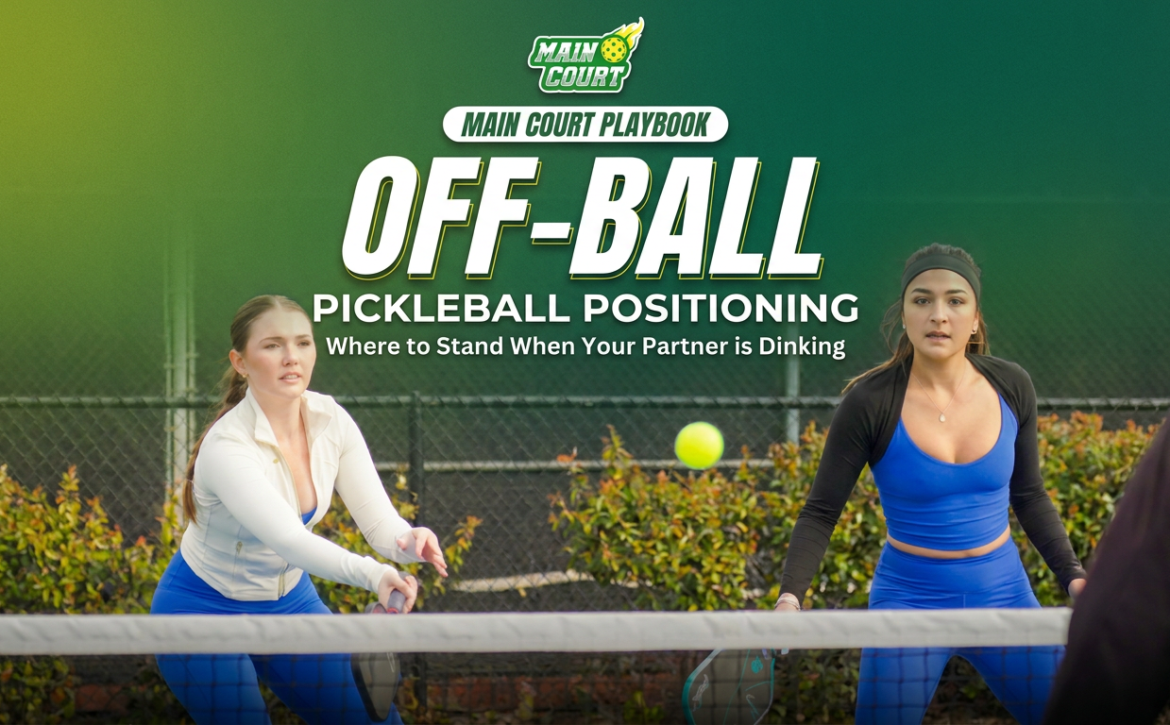
When your partner is dinking at the kitchen line, what are you doing? Most recreational players either crowd their partner, drift too wide, or just watch the rally hoping nothing comes their way. That's leaving points on the table. The off-ball player has a specific job — and once you understand it, your team's court coverage goes from reactive to coordinated.
The two roles of the off-ball player
Your off-ball pickleball positioning switches between two modes depending on where your partner is on the court. When your partner is dinking wide crosscourt, you become the pressure player — positioned about one step from the middle, covering the seam and ready to attack. When your partner moves to the middle, you shift into a defensive wall — slightly back, focused on reach and countering anything redirected your way. The mistake most players make is staying in one fixed position regardless of where their partner moves. Your positioning must be dynamic, not static.
Never crowd your partner
This is the most common off-ball positioning mistake we see across all skill levels in our community. When you drift too close to your partner, you double-cover one side of the court and leave a massive gap on the other. Your partner doesn't need help covering their zone — they need you covering yours.
💡 Quick rule: If you could reach out and touch your partner, you're too close.
Maintain enough separation that you can each cover your side independently while together closing the middle seam. Adjust your position dynamically based on where your partner is at all times.
Full tracking vs half tracking: how to watch the ball
As the off-ball player, how much you turn your head to follow the ball matters more than most players realize. There are two approaches and each has a tradeoff.
Full tracking means turning your head completely to follow the ball. You get the best read on trajectory and direction — especially important when your partner is moving unpredictably or playing off the kitchen line. The downside is it can be slightly slower in fast exchanges.
Half tracking means keeping your head more forward and using peripheral vision to monitor your partner's paddle while watching the ball at the edges of your vision. Faster reaction time but riskier if the opponent changes direction abruptly.
For most players at the 3.0–4.0 level, default to full tracking until your court awareness and pattern recognition improve naturally.
When you're the pressure player
When your partner is dinking wide crosscourt, your job is to apply pressure from the middle. Position yourself about one step from the center line — close enough to close the middle seam quickly, far enough to cover the line if needed. You're not just waiting. You're threatening. Your presence in the middle forces the opponent to think twice about attacking through the seam, which opens up better opportunities for your partner's dinking angle. Stay light on your feet and be ready to intercept anything that comes through the middle.
When you're the defensive wall
When your partner moves into the middle to apply pressure, your role shifts to defense. Step back slightly, widen your base, and focus on reach. You're the backstop — your job is to handle anything that gets redirected your way, whether it's a flick down the line or a reset dink. Stay neutral, watch the opponent's paddle face, and react. Your backhand is usually your primary weapon in this position since most attacks from the middle come cross-body.
Off-ball positioning and your skill level
Off-ball awareness is one of the clearest markers of a player moving from 3.5 toward 4.0 and beyond. Players who understand off-ball pickleball positioning feel like they always know what's coming — because they've trained their reads. If you're not sure where you sit on the skill scale, take the free 3-minute skill assessment and use it as a baseline. Focus on the off-ball habits in this post and reassess in a month. The improvement will be measurable.
Pickleball 3.5 to 4.0: 8 Skills That Bridge the Gap
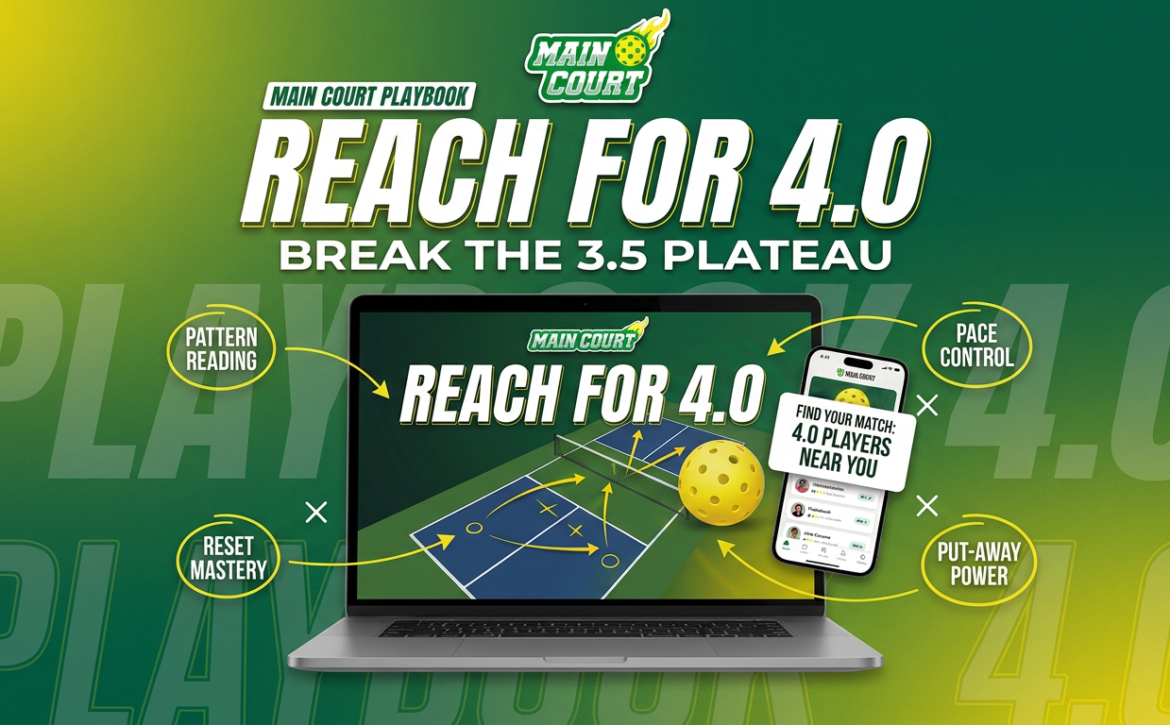
If your pickleball 3.5 to 4.0 jump feels stuck, you are not alone. Your shots are clean, your technique is solid, but the breakthrough has not clicked.
The gap is real. But it is a step ladder, not a chasm. Below are eight skills that bridge it: five strategic, three technical.
4.0 by the numbers
6+
consistent dinks per rally
80%+
of third shots are drops
100%
put-away on shoulder-high balls
What you'll learn
1. Efficient hands beat fast hands2. Watch patterns, ignore highlights3. Pace control: absorb, don't push4. Reset before you lose the point5. Transition forward off the third6. Dink consistently, not aggressively7. Default to the drop on thirds8. Crush every shoulder-high ball
Part One · 5 Strategic Skills
1
The shortcut to fast hands isn't speed
Watch a 4.5 player at the net and it looks like pure reaction speed, but there is a step before speed that almost nobody talks about: efficiency. Most intermediate players lose hands battles because their paddle takes the long way to the ball. Big windups, side-to-side swings, paddle drifting out of the frame.
The shortest distance between two points is a straight line. Get your paddle in the path of the ball as quickly as possible, and that is it. Don't think fast, think efficient. The speed comes later, layered on top of efficiency. Try to skip this step and your reactions will just spray balls everywhere.
Drill it
Keep the paddle out in front, in your peripheral vision, at all times. Point A to point B. No detours.
2
Watch the patterns, ignore the highlights
Predicting your opponent is one of the most satisfying parts of advanced play, but the trap is trying to read everything they do. You don't need to. You just need to ignore one-offs and notice patterns.
If your opponent rips a wild two-handed backhand passing shot once, let it go. Twice, file it. The third time, you have a pattern, and now you can sit on it. Counter once, and you have done more than win the point. You have told them, "I am watching." That mental pressure is half of what separates 3.5 from 4.0.
3
When pace comes in, pace comes out
Most intermediate players try to do too much with the ball. Here is the rule: pace control is about your opponent, not you. When pace comes in, pace comes out. That is just physics. Push the paddle forward on a hard shot and you will send it past the kitchen every time.
The fix is mechanical. Instead of pushing the paddle forward, learn to bring it slightly in toward your body to absorb the pace. Stand in the transition zone, have a partner at the kitchen rip hard shots at you, and practice dropping them dead in the kitchen. Repeat until trusting the incoming pace feels normal.
4
Reset the point before you lose it
Resetting is the moment in a point when you realize, "We are about to lose this. I need to slow it down." It is pure self-awareness, and it is the single most underrated skill in pickleball.
Picture this: you and your partner are on the baseline, your opponents are at the net, and they just slammed your third back at your feet. They have the advantage. Your job now is not to hit a winner. It is to neutralize. Put the ball below the net somewhere in their kitchen. Below the net forces them to hit up. Up means soft. Soft buys you time to get forward.
"
Intermediate players let chaos win the point. Advanced players reject the chaos and reorganize.
5
Pickleball 3.5 to 4.0: the transition is everything
The transition, meaning moving from the baseline to the net after your third shot, is what defines higher-level play. Pickleball points are won at the net. Period. Most 3.5 players know this and still don't move forward, because it feels scary. That is the pressure paradox.
If your third shot is decent (low, with topspin, making your opponents move) and you don't follow it forward, you have wasted it. They can hit anything they want because you are nowhere near the net to take it out of the air. The quality of your third only matters if you back it up with your feet.
Flip it: when you move forward, your opponent's brain shifts. Suddenly they have to think about shot selection, not offense. They can't lazily lob or attack low. They have to play defense. Moving forward feels riskier, but it is what puts the pressure on them.
If your third pops up, hold the transition zone and reset (skill 4). If it is low or moving them, book it. Not sure where you actually sit between 3.5 and 4.0? Our pickleball skill level assessment is a quick gut-check before you start drilling these.
"
The more you move forward physically, the more you move forward developmentally.
Part Two · 3 Technical Fundamentals
6
Dink consistently, not aggressively
At 3.5, dink rallies are short. Two or three exchanges and someone pops one up or pushes one out. At 4.0, you have to hit four, five, six, sometimes eight or more consistent dinks in a row before anyone breaks. The dinks do not need to be offensive. They need to land in the kitchen, every time.
The mechanics are simple, and that is the point. Low knee bend, paddle out in front, minimal backswing, minimal follow-through. Most 3.5 players lose dink rallies because they try to do too much: bigger backswings, swinging finishes, paddle behind the body. Every extra motion is a new way to miss. Keep it tight.
Drill it
Forehand, backhand, cross-court, line, it does not matter. Paddle in front, minimal swing, ball in the kitchen.
7
Default to the drop, drive only on high returns
Skill 5 said get to the kitchen. This is how. Most coaches will tell you to hit drops on 60 to 70 percent of your third shots. At the 4.0 level, that number should be higher. Plenty of advanced players hit drops on 90 percent of their thirds, because their first job is getting to the kitchen line, not winning the point from the baseline.
Drives are for one situation only: when the return floats up high enough that you can step in, contact it above your knees, and drive it down into your opponents' feet. Anything lower than that becomes a drop. Try to drive a low return and you are either dumping it in the net or getting stuck back in no man's land for three more shots.
The pattern is: drop the third, move up to the transition zone, stop when your opponent contacts the ball, then close to the kitchen line on the next shot. Now you are even, and the dink battle begins.
8
Crush every shoulder-height ball
This is the skill that flips dink rallies into point wins. At 3.5, players see a high ball and tap it back firmly. At 4.0, anything at shoulder height or above gets crushed, every single time. Soft returns of high balls are how 3.5 players give back the point they just earned.
The technique matters. Paddle on top of the ball, contact point about six inches in front of your body, swing straight through with intent. Not a huge backswing, just enough room behind you to generate paddle speed. Aim down at your opponent's feet, not flat across the court.
If you let the ball get next to you or behind you, all you can do is flick at it. No paddle speed, no put-away. Step into it, contact it out front, and finish.
Drill it
Shoulder height or above? Hit it down. Every time. No exceptions.
The catch
You can't drill these skills alone
Every skill on this list needs reps against players who'll actually challenge you. Six-dink rallies, transition pressure, put-away setups. None of it happens with the same open-play crowd that lets you coast.
Most 3.5 players stay stuck not because they can't learn the skills, but because they can't find pickleball players near them at the right level. Facebook groups and group chats are the worst possible matchmaking layer. That is the real bottleneck between 3.5 and 4.0, and it is exactly what Main Court fixes.
Drill against opponents who'll actually push you
None of these skills develop in a vacuum. Find a regular hitting partner a level above you, drill the absorb-and-reset pattern, push every third as a drop, and finish every shoulder-height ball. Six weeks in, you'll feel the rung shift.
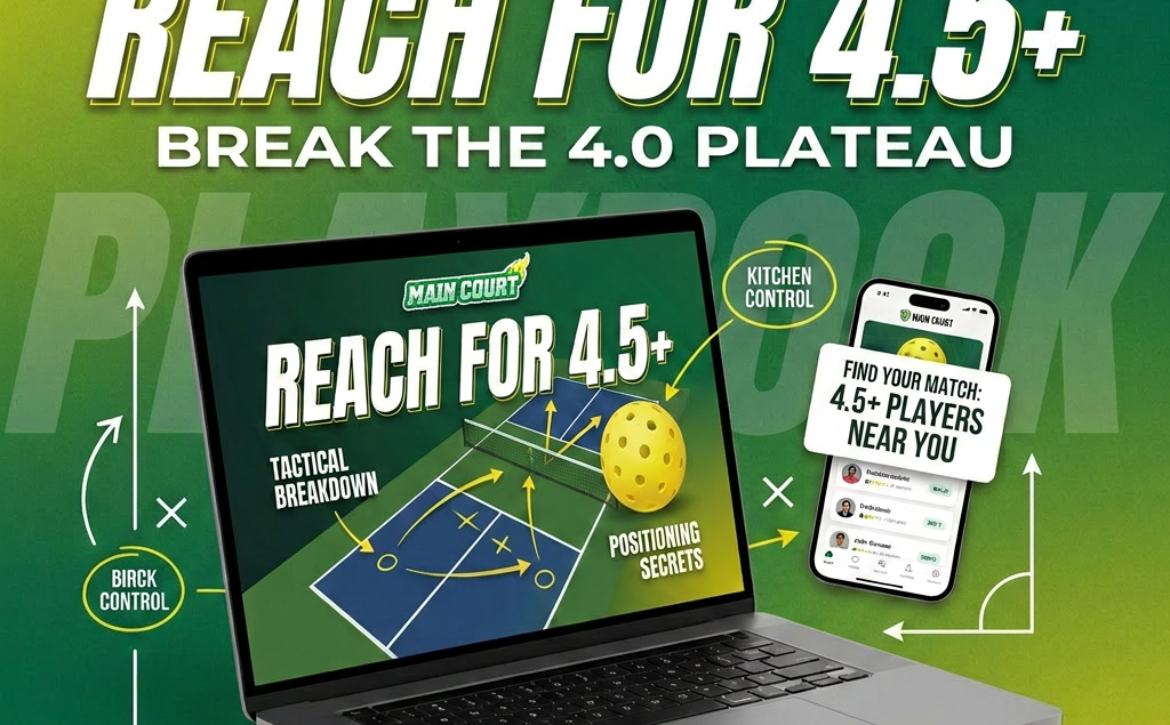
Almost every regular pickleball player hits the 4.0 pickleball plateau. From what we see across the Main Court community, the wall is rarely about technique — paddle skill at 4.0 looks broadly similar to paddle skill at 4.5. What changes is everything that happens between the shots: positioning instincts, shot selection, recovery habits, how you weight the next moment. Below are five recurring habit shifts we see in players who eventually break through, plus the part nobody talks about enough — how finding pickleball matches at your correct skill level is the single biggest accelerant for any of it.
1. Treat dinks like geometry, not artistry
At 4.0 most players’ dinks aren’t sloppy — they’re beautifully struck and landing in useless spots. Cross-court, only two zones genuinely pressure the other side: the wide back corner of their kitchen, and the back of their kitchen toward the centerline (right at their inside foot when they’re set). Everything in between is a soft pitch onto their forehand. Cycle between those two zones, accept that some attempts sail long, and stop feeding the backhand flick you’re about to get burned on.
2. Pattern recognition beats prediction every time
Watch a 4.5 rally and the players look like they’re reading minds. They aren’t. They’re running a mental lookup table of patterns they’ve seen hundreds of times and reacting fractionally faster than everyone else. Here’s one pattern you can bank tomorrow: a low flick aimed across an opponent’s body comes back to your same side roughly 90% of the time. So the higher-level player doesn’t guess — they pre-load. Weight shifts before the ball clears the net, paddle is already in the lane, the counter arrives exactly where they expected it to. The skill isn’t prediction. It’s a library, and the library only grows when you play opponents who haven’t already shown you their cards.
3. Floated a dink? Your next priority is positioning, not paddle
Every advanced player puts a dink in the air occasionally. The plateau habit is to brace stiff and prepare for “anything” coming back. Problem: anything isn’t equally likely. Against a right-handed opponent, the speedup through the middle seam is the highest-probability attack from a dead dink — by a margin that isn’t close. So default your paddle and your body into the middle. Cover the angle as the secondary read. Most stuck players obsess over reset technique and almost never train where they should be standing after a bad reset. Flip the ratio.
4. Pace at contact is doing all the work — not paddle face
This is the diagnosis plateaued players resist longest. They’ll tinker with grip, contact spot, paddle face angle, anything except the actual culprit — how fast the paddle is moving when it meets the ball. A dink only fails when it travels too far past the line, and that distance is governed by one variable: pace at contact. So when you’re stretched or scrambling, the right move is counterintuitive: swing slower, not harder. Decelerating reclaims depth, restores balance, and keeps you alive in the point instead of handing it over to a put-away.
5. Wide base for range, soft hands when the ball dips at your feet
Two habits combine here and you need both. First: a narrow stance is a hard cap on lateral range. You physically cannot shuffle wide from a stance that hasn’t pre-loaded the push, so reset into a wide athletic base between every point. Second: when the rally pulls you wide and a kicking ball is dipping at your shoelaces, do not hit topspin. The contact point is below kitchen-line height, topspin sends it long, and the other team rolls it back at your feet. A slice, cup dink, or soft block keeps you in the rally. Topspin into a low wide ball is how someone else’s highlight reel ends up with you in the background.
The part nobody talks about: finding pickleball matches at your correct skill level
Every plateau breakthrough we see follows the same shape. The player stops grinding mixed-level open plays and starts finding pickleball matches at their correct skill level. Here’s why that matters more than another paddle change or YouTube binge: playing exclusively against stronger opponents means you never close out points or test your reset under real pressure. Playing exclusively against weaker opponents means none of the five habits above ever get challenged. The sweet spot is consistent, level-matched competition — opponents half a step ahead or behind you, who force the decisions and reward the right ones. Playing at your correct skill level isn’t a small input. In our experience running the platform, it’s the single biggest factor separating pickleball players who climb from players who plateau — far outweighing technique tweaks, gear changes, or hours logged. If you don’t know where you actually sit on the 1.0–5.0 scale, take the free 3-minute skill assessment and then play the people the system surfaces. The compounding starts immediately.