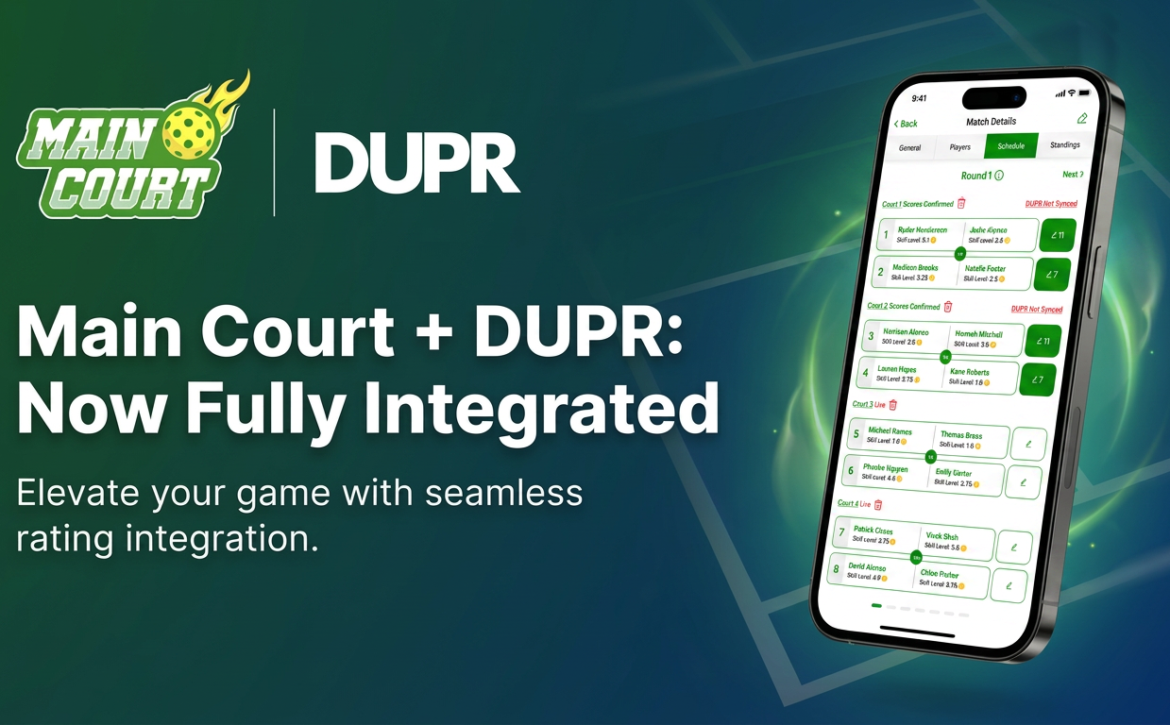
Main Court and DUPR launch a full integration — players can now see their DUPR rating inside Main Court, run DUPR-rated Round Robins, and automatically sync match scores to DUPR.
Round robins sound complicated—but they’re actually the fairest way to determine the best players in your group. With the right free pickleball round robin app, organizing one becomes simple: everyone plays everyone else once, and final standings are determined by total wins and point differential.
No single loss knocks you out. No waiting around for bracket play. But the execution—tracking all those matches, recording scores, calculating tie-breakers, and managing court rotations—is where most organizers either fumble or reach for a spreadsheet and a calculator.
Myth #1: Round Robin Scoring Is Too Complex
Here’s the reality: it’s not. The confusion usually comes from trying to do it by hand.
Every player competes against every other player in your group. Each match generates a winner and a loser. At the end, you tally wins and calculate point differential (total points scored minus points allowed). Ties are broken by head-to-head record, then point differential, then points scored. That’s it.
The three ways to score each match are:
Win/loss record – 1 point for a win, 0 for a loss (simplest)
Game-based scoring – Points awarded for each game won in a multi-game match
Point differential – Points for wins plus bonus points based on margin of victory
Most community round robins use the first method because it’s clear and fair. Courts rotate systematically—if you’re on Court A for Match 1, you move to Court B for Match 2, and so on—so no pair of players gets an unfair advantage or disadvantage.
Myth #2: Manual Scoring Is “Good Enough”
Maybe for a casual 4-person friendly. For anything bigger, it creates chaos.
Spreadsheets require someone to manually enter every score, recalculate standings after each match, and hunt down tiebreakers. One typo or missed entry derails the whole round robin. Players get frustrated when standings don’t update in real time. Organizers spend the entire event glued to a laptop instead of actually enjoying the event.
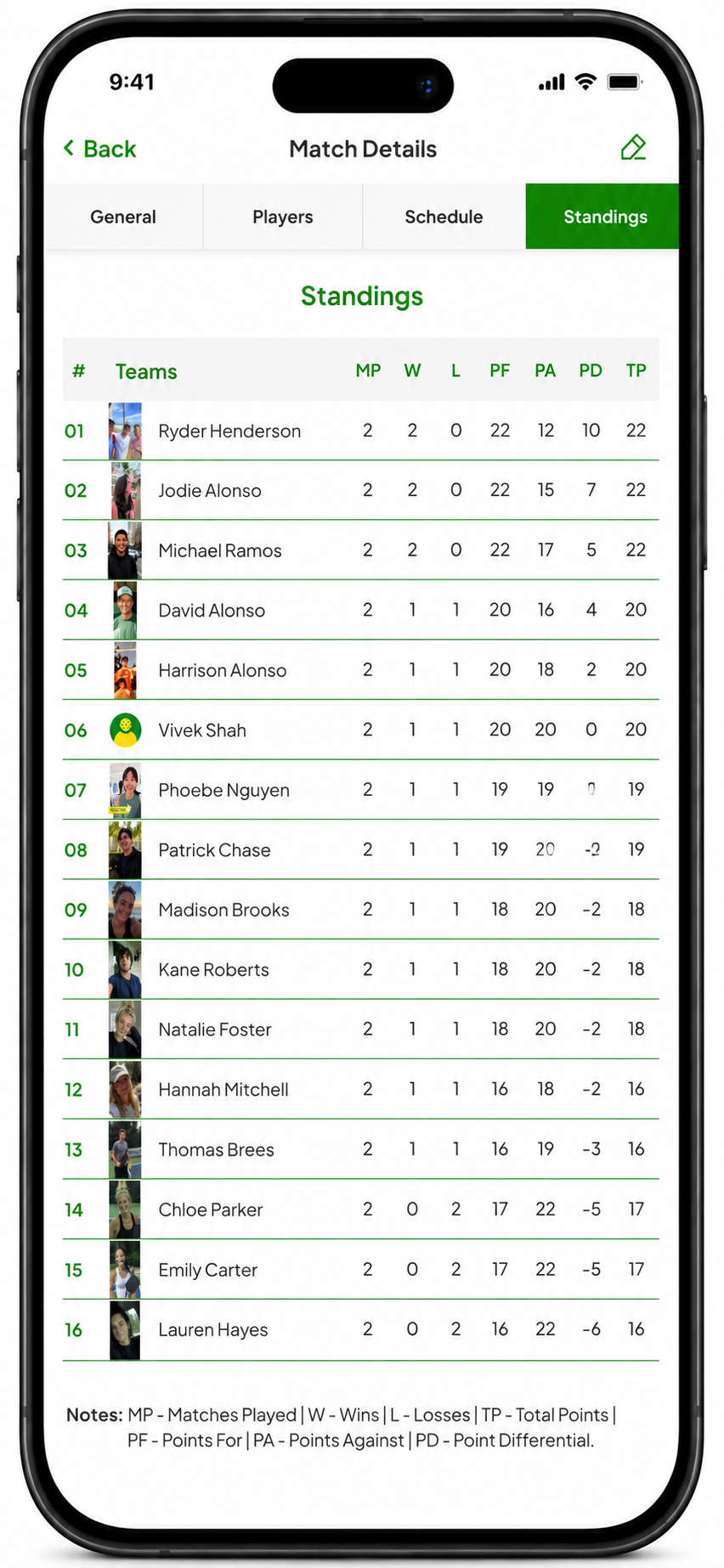
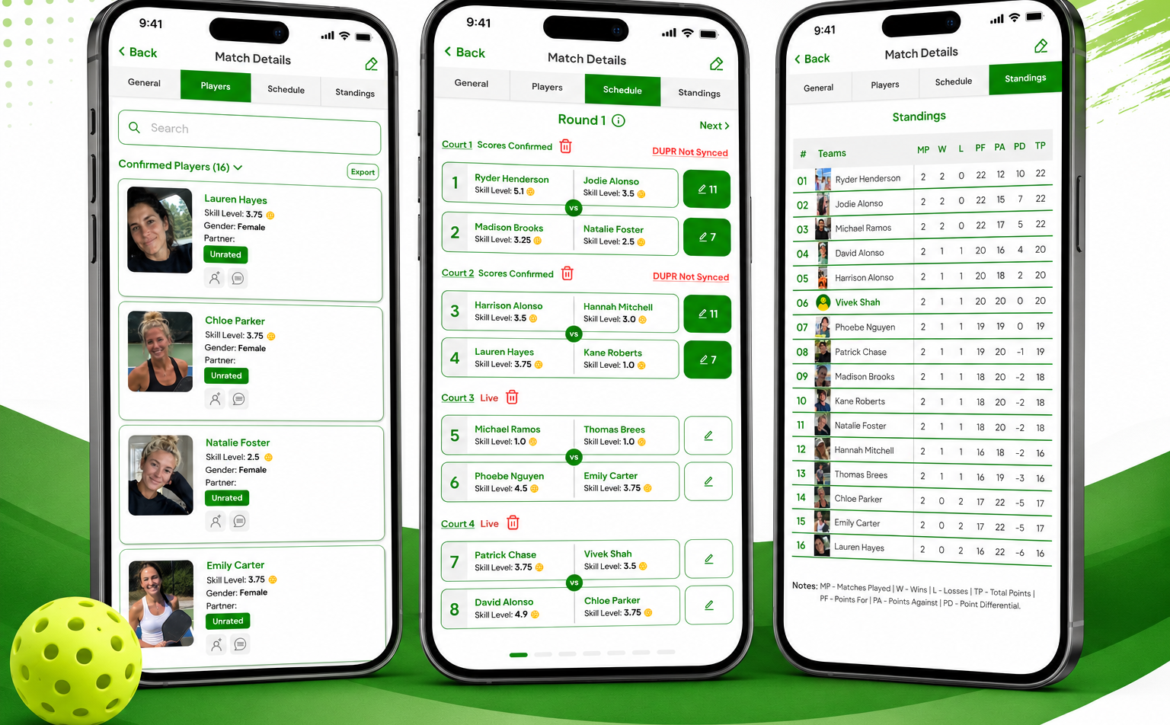
That’s why Main Court’s free pickleball round robin app handles the heavy lifting: every score is recorded instantly, standings update live, and tiebreakers are computed automatically.
When you set up a round robin on Main Court, the app automatically generates the match schedule, assigns court rotations, and displays the live leaderboard. Players see their next opponent and court in real time. Scorekeepers tap in results, and standings update instantly. No tie-breaker math, no confusion—the system handles it.
How many players can a round robin have? Theoretically unlimited, but 6–12 players per group is ideal—it keeps match count manageable and the event flowing.
What if two players end up tied? Tiebreakers apply in order: head-to-head record, point differential in head-to-head matches, total point differential, total points scored.
Can I use round robin for mixed-skill groups? Yes—use skill level assessment to ensure balanced groups, then run round robin within each group.
Round robins reward consistency and fair play—no luck, no bracket upsets, just the best players rising to the top. The only question is: are you going to manage it with a spreadsheet or let Main Court handle it?
Download the Main Court app and run your next round robin with zero manual scoring, live leaderboards, and happy players. It’s free.
You have eight players, two courts, and ninety minutes. Everyone wants real games against different people, nobody wants to stand around, and you do not want to play referee all afternoon. The format that solves all of that is the round robin, and it is the single most useful thing an organizer can learn to run.