
How to Run a Pickleball Round Robin (Step by Step)
You have eight players, two courts, and ninety minutes. Everyone wants real games against different people, nobody wants to stand around, and you do not want to play referee all afternoon. The format that solves all of that is the round robin, and it is the single most useful thing an organizer can learn to run.
The catch is the schedule. Figuring out who plays whom, on which court, in which round, is where most round robins fall apart. This guide walks through how to run a pickleball round robin from scratch, the formats to choose from, and the fastest way to skip the math entirely.
What Is a Pickleball Round Robin?
A pickleball round robin is a format where every player, or every team, plays against all the others in the group, rather than being knocked out after a single loss. Everyone keeps playing for the whole session, and the winner is whoever finishes with the best overall record once all the games are done.
Because no one is eliminated, a round robin guarantees plenty of court time and naturally balanced matchups, which is why it is the go-to format for open play, social mixers, leagues, and club events. It works with as few as four players and scales up to 20, 30 or more, and in the popular partner-rotation version you switch partners each round so you team up with different people.
Why Run a Round Robin?
Single-elimination brackets are great for crowning a champion fast, but they send half your players home after one game. For a rec session or a social, that is exactly what you do not want. A round robin keeps everyone playing and tends to produce a fairer result.
- Maximum court time. Players come to play, not to watch. A round robin keeps everyone in games.
- Fairer outcome. One bad game does not end your day. Standings reward consistency across the whole session.
- Better matchups. In partner-rotation play, you mix with stronger and weaker players, which keeps games competitive.
- It is social. Switching partners and opponents every round means you actually meet the people you came to play with.
What You Need Before You Start
- A confirmed player count (and a plan for late additions or no-shows).
- The number of courts you have and how long you have them.
- A scoring system everyone agrees on before the first serve.
- A schedule that pairs players and assigns courts for every round.
- A simple way to track scores and standings as you go.
How to Run a Pickleball Round Robin, Step by Step
1. Choose your format
Decide first whether teams stay together or partners rotate. Fixed partners keep the same two players together for the whole event. Partner rotation (sometimes called a mixer or scramble) switches your partner each round so everyone plays with everyone. Rotation is the most popular choice for socials because it balances out skill levels.
2. Count players and pick a schedule
Your player count drives everything. With multiples of four, doubles slot in cleanly. With odd numbers, you build in a short bye each round so no one sits for long. Match the number of simultaneous games to your number of courts.
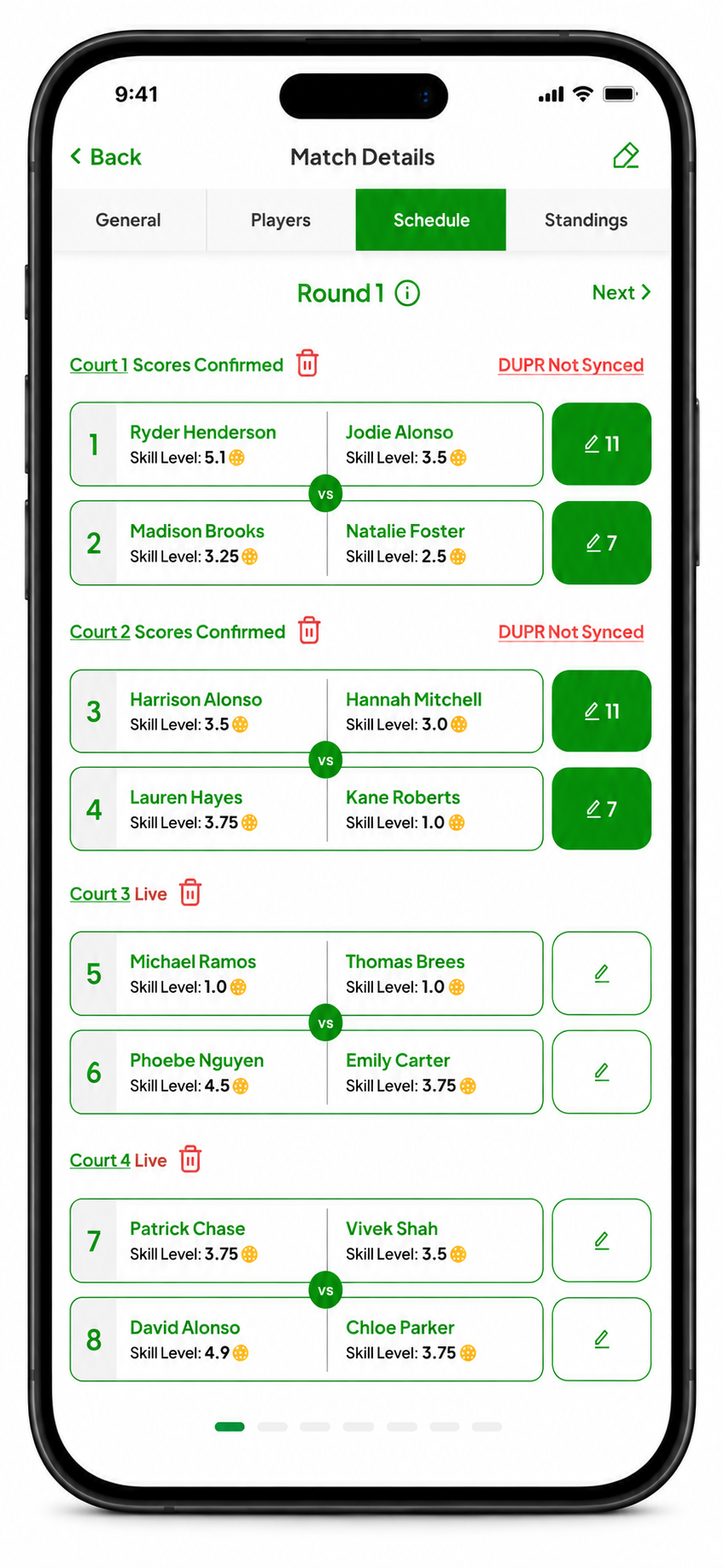
Main Court builds every round across your courts automatically, no spreadsheet.
3. Set the scoring
For round robins, short games keep the rounds moving. Common choices are games to 11 win-by-2, games to 9, or timed rounds (for example 8 to 10 minutes) with the leading score when time is called. Pick one and tell everyone up front so rounds end on schedule.
4. Build the round robin schedule
This is the part that trips people up. Each round needs every player paired and assigned to a court, with no one double-booked and byes spread evenly. For small groups you can draw it up by hand using a rotation chart. For larger groups it is far easier to use a generator so the matchups and byes balance automatically.
5. Set up courts and rotation
Number your courts and post the schedule where everyone can see it. Call rounds clearly, and have players report scores at a central spot before they head to their next court. A consistent rotation keeps a session of 16-plus players running without a traffic jam.
6. Track scores and standings
Record each game as it finishes. Rank players or teams by wins first, then use point differential as the tiebreaker. Keeping a running standings sheet visible adds friendly competition and saves a scramble at the end.
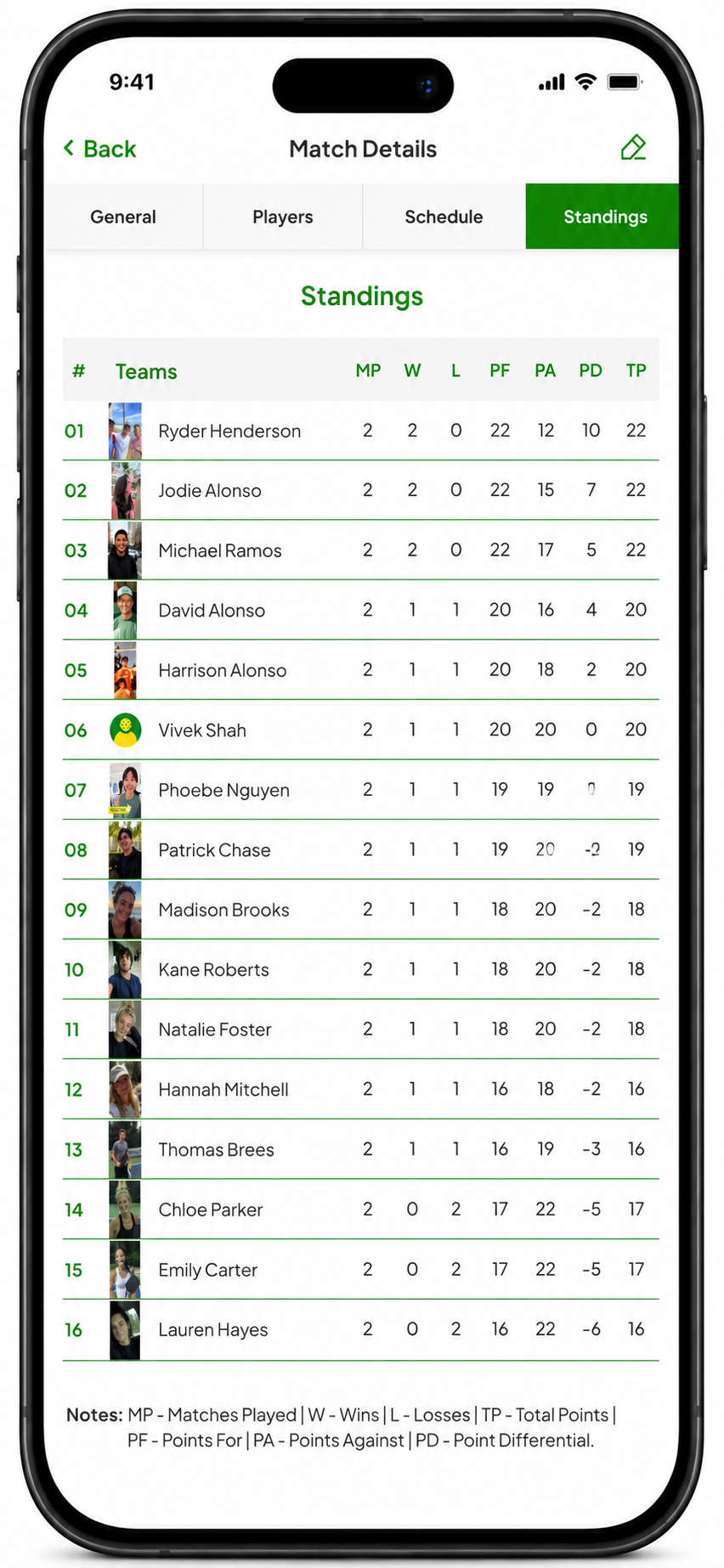
Live standings rank everyone automatically by wins, then point differential.
7. Crown the winner and share results
When the last round is in, the best record wins. Announce the standings, thank everyone for coming, and share the results so players can see how they did and look forward to the next one.
Round Robin Formats Explained
A few variations cover almost every session you will run:
- Doubles round robin (fixed partners). Teams stay together and play every other team. Best for leagues and more competitive events.
- Partner-rotation mixer. You change partners each round and your wins follow you individually. The friendliest, most social format.
- Singles round robin. Every player faces every other player one-on-one. Great for small, competitive groups.
- King (or Queen) of the Court. Winners move up courts, losers move down, and you re-pair each round. A fast, high-energy cousin of the round robin.
Common Mistakes to Avoid
- Building the schedule on the fly. Sort matchups and byes before players arrive, not while they wait.
- Uneven byes. If your numbers are odd, rotate the bye so the same person is not always sitting.
- Games that run long. Pick a short scoring format so one slow court does not stall the whole rotation.
- No central scorekeeping. Without one standings sheet, the final result turns into an argument.
The Easy Way: Let Main Court Build It
Everything above works on paper. The reason organizers dread round robins is the schedule math, especially once you pass a dozen players. That is exactly what Main Court’s free pickleball round robin app takes off your plate.
Set your players and courts, and Main Court generates a fair schedule in seconds, balances byes automatically, tracks scores and live standings, and lets players see their own matchups on their phones. You spend the session playing, not refereeing a spreadsheet. And because players are already on Main Court, it is just as easy to find players near you to fill the next one.
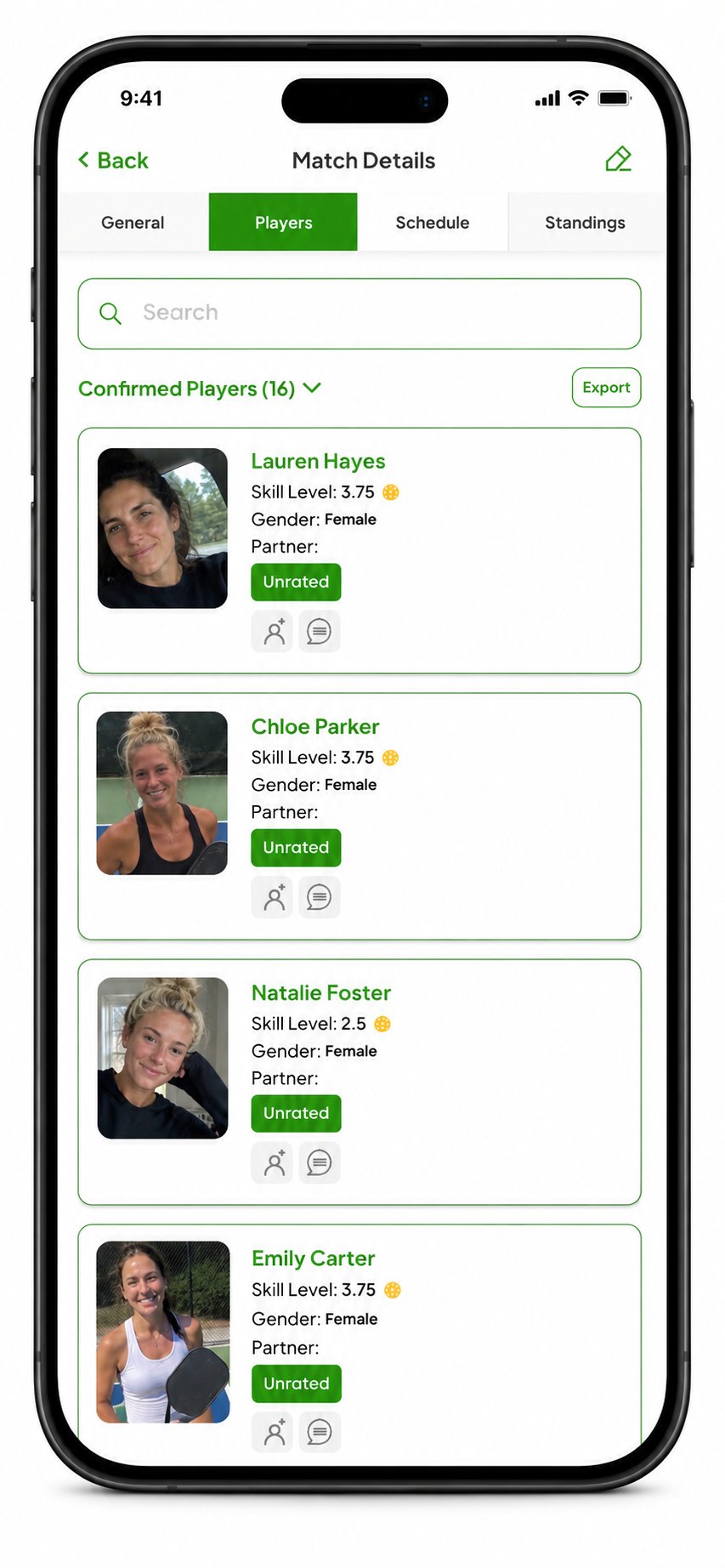
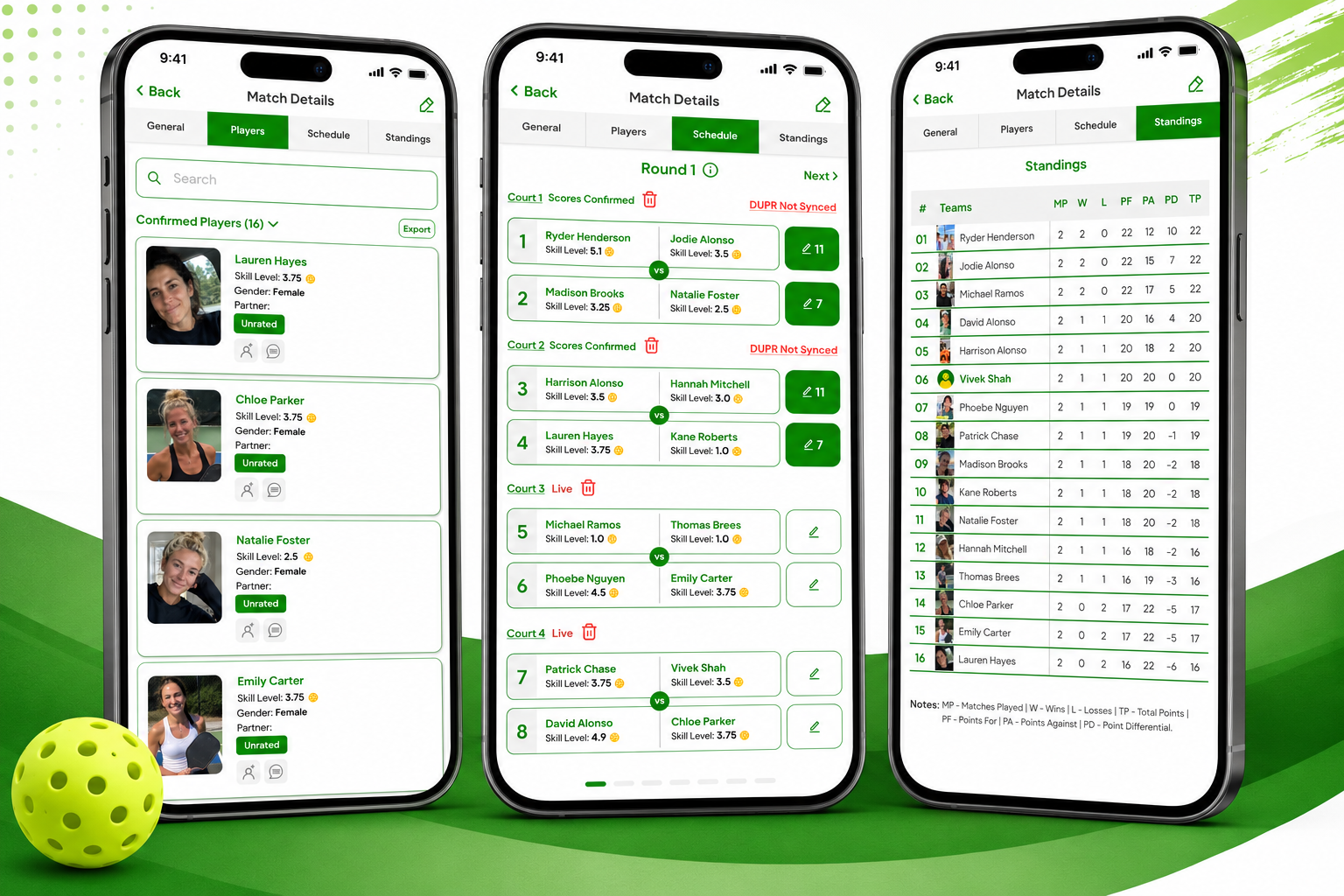
From confirmed players, to a live schedule, to automatic standings, the whole round robin runs in one place.
Doing It By Hand vs Main Court
| By hand / spreadsheet | With Main Court |
| ✗ Work out every pairing and bye yourself | ✓ Fair schedule generated in seconds |
| ✗ Re-do the chart when players add or drop | ✓ Adjusts instantly to your final headcount |
| ✗ Chase scores on paper at one table | ✓ Scores and live standings on every phone |
| ✗ Uneven byes and double-booked players | ✓ Byes spread evenly, no court clashes |
| ✗ Hard to run anything past about 12 players | ✓ Scales to 20, 30 or more without the headache |
The Bottom Line
A round robin is the best way to give a group of pickleball players a full, fair, social session. Choose your format, set short scoring, build a balanced schedule, and keep one running standings sheet. Do that and everyone leaves having played a lot of good games. Let the app handle the schedule and you get to actually enjoy the day with them.
Run your next round robin in seconds
Download the Main Court app
Join thousands of pickleball players. Free on the App Store and Google Play.