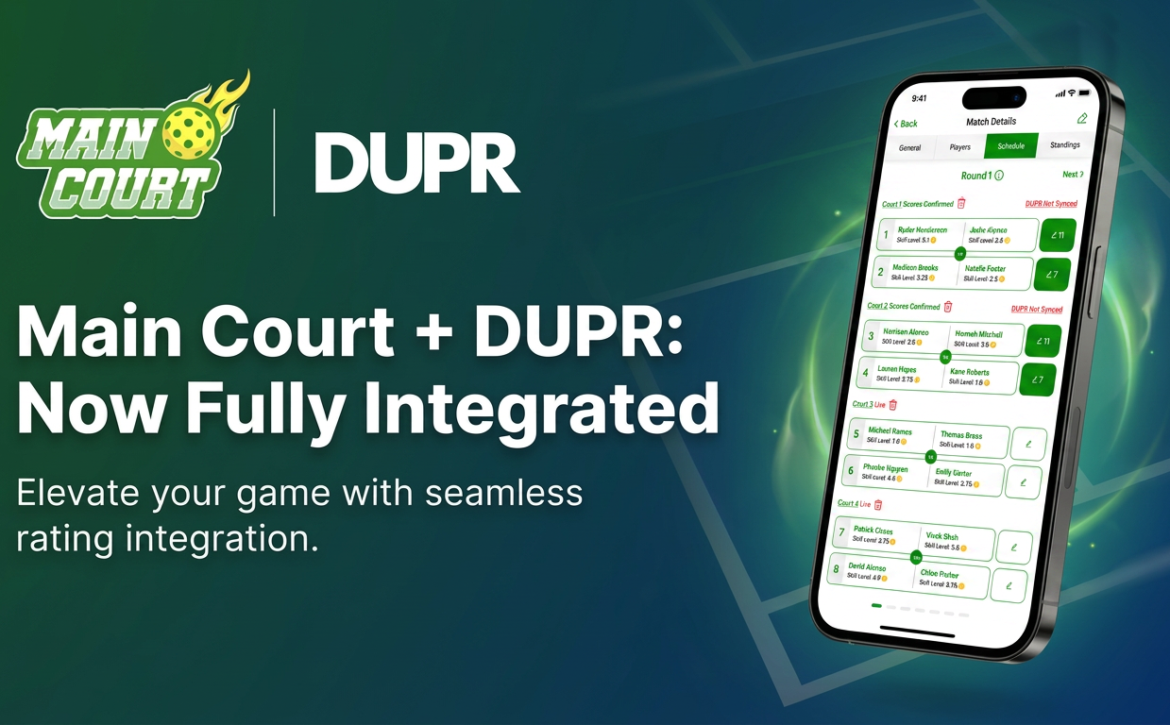
Main Court and DUPR launch a full integration — players can now see their DUPR rating inside Main Court, run DUPR-rated Round Robins, and automatically sync match scores to DUPR.
Maybe you just moved. Maybe you're new to the sport. Maybe your usual crew keeps flaking and you're tired of rebuilding a roster every Sunday morning. Either way, you need to find pickleball players near you, and if you're like most people, your first instinct was to join a Facebook group, type "anyone in [your city] want to play?", and wait. And wait.
Facebook Groups Were Built for Discussion. Not Discovery.
Facebook groups are forums. They are optimized for people talking to each other in a feed: sharing tips, posting memes, occasionally arguing about paddles. They are not optimized for finding a specific human within a few miles of you, who plays at your level, who is free Saturday at 9am, and who you can actually trust to show up. Nobody built them for that, and it shows every time you try to put together a game.
Yet that's how most rec players still try to find pickleball partners. Not because it works, but because nothing better existed in their head. Until they tried Main Court.
What "Finding Players" Looks Like in a Facebook Group
Here's the typical post in any "[Your City] Pickleball" Facebook group:
Posted in: San Diego Pickleball · 12,400 members
Hey everyone, just moved to North County, looking for 3.5 to 4.0 players. Free most evenings and weekends. DM me!
↳ Anna: I'm a solid 3.0, wanna come hit?
↳ Mike: Whereabouts in North County? I'm in Carlsbad
↳ Steve: I'm a 4.5 but happy to play down
↳ Kim: Are you free Saturday? My group needs a 4th
↳ Diana: What courts do you usually play at?
Seen by 847 · Useful replies: 1.
Sound familiar? You posted into a feed that shoved your request in front of thousands of people who don't match what you need, and the few who replied are strangers with no track record. That's not a community problem. That's a tool problem.
8 Ways Facebook Groups Fail You for Finding Pickleball Players
What you actually need
Facebook Groups
Main Court
Skill-level filter
✗ Everyone replies, levels guessed
✓ Main Court and DUPR skill-level filtered results
Verified rating with rating count
✗ "I'm a 4.0, trust me"
✓ Skill rating plus the number of players who rated them
Player recommendations
✗ Strangers with no signal
✓ Highly Recommended and All Star badges from past partners
Match history visible
✗ No history, no context
✓ See who they've played and how often
Distance from you
✗ City-wide feed
✓ Map and radius, sorted by distance
Availability filter
✗ DM and ask, then wait
✓ Calendar-based, by day and time
Direct match request
✗ DM chain, maybe a game
✓ One tap, request, auto-confirm
Recurring partners
✗ Hope you bump into them
✓ Save players, get notified when they post a game
💡 Tip: Most of your "find a partner" misses come from skill mismatch. Take the free pickleball skill level assessment before you start searching so your results actually fit your game.
The Geography Problem with Facebook Groups
Facebook groups are organized by city ("San Diego Pickleball," "Austin Pickleball Community"), but the courts you'd actually drive to are within 5 to 10 miles of where you live. A city-wide group dumps everyone in the same feed. You're seeing posts from people 25 miles away and completely missing the player who lives three blocks over because they posted in a different group, or didn't post at all.
Main Court is map-based. When you open the app, you see open matches and active players sorted by distance from you. No "is Encinitas too far?" math. Just who's nearby and when they're free.
The Skill Level Guessing Game
Every Facebook pickleball group has the same problem: nobody is the level they say they are. A self-described "3.5" can be anywhere from a real 2.5 to a sandbagging 4.0. You can't filter the replies, you can't verify levels before agreeing to play, and the only way to find out is to show up and discover the mismatch in person, which usually means one of you has a bad game.
Main Court uses skill ratings (with DUPR integration) plus rating counts from other players. A 4.0 with 60 ratings tells you something fundamentally different from a 4.0 with two. Set your range, and only players who actually fit show up.
The Trust Problem: You're Playing With Strangers
The deeper issue with Facebook groups isn't just skill or distance. It's that you have zero signal about the human on the other side of the message. Their level is whatever they claim. Their reliability is unknowable. The only thing you've got before driving to a court is a name and maybe a profile picture.
Main Court puts trust signals on every player profile. Their skill rating shows how many other players have rated them. Recommendations from past partners show up directly as badges: Highly Recommended, Main Court All Star. And you can see their match history before you ever send a request: who they've played, how often, how recently. Fifty matches in the last six months tells you one story. Three matches and a long gap tells you another.
You don't have to show up and hope. The information is on the screen before you commit.
How to Find Pickleball Players Near You: The Right Way
Find people you'll actually want to play with again.
It's two taps on Main Court.
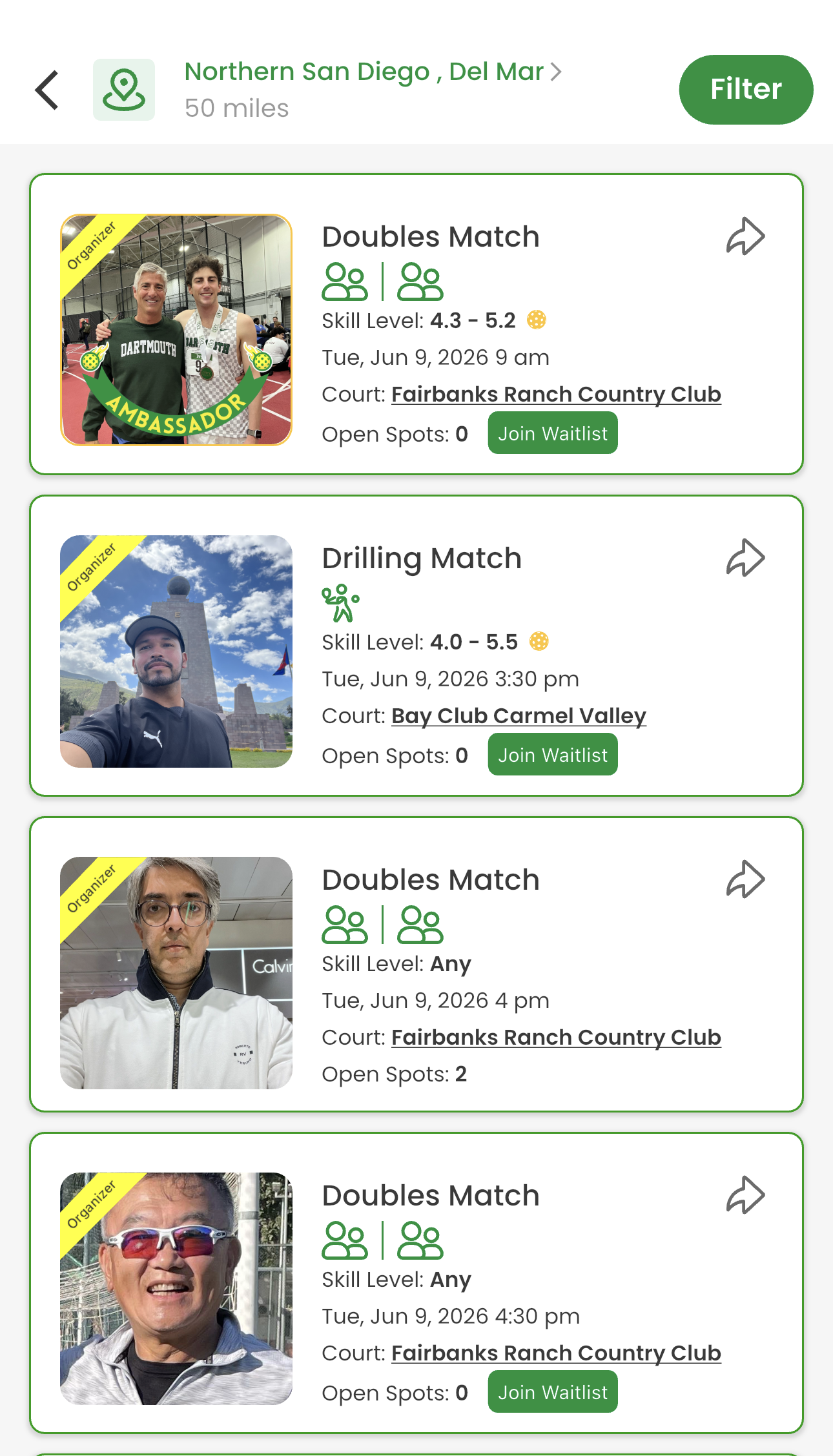
To find a game, open the app to the Open Matches feed. Set your location and radius (say, 50 miles around Del Mar), and you see every nearby match with its skill range, date, court, and open spots. Tap one that fits, request to join, and you're in. If it's full, hop on the waitlist and you get auto-promoted when someone drops.
Open Matches feed: skill range, court, date, spots left. Tap to join.
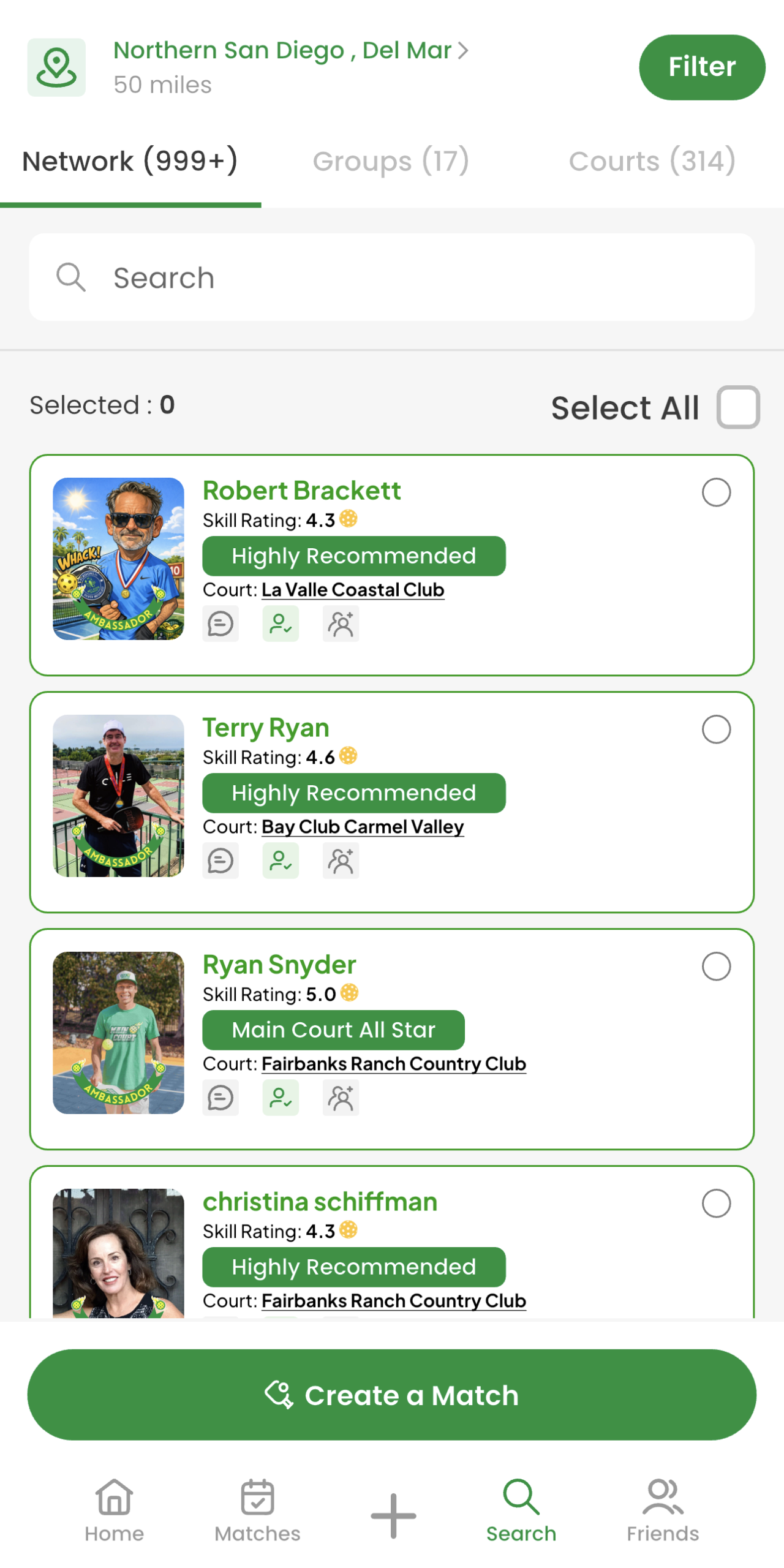
To find players, tap the Search button. You see your local network sorted by proximity, each card with their skill rating, recommendation status (Highly Recommended, Main Court All Star), and home court. Tap a player to see their full profile, recommendations, and match history before you ever send a request. Or hit Create a Match and invite the people you actually want to play with.
Search: local network with skill ratings, recommendation badges, and home courts.
That's it. No Facebook group. No DM chains. No "anyone playing Saturday?" posts shouted into the void. By the time you walk onto the court, you already know who you're playing.
Stop Looking for Pickleball Players in Facebook Groups
Find pickleball players near you, at your skill level, with the ratings and recommendations to back it up, in under a minute.
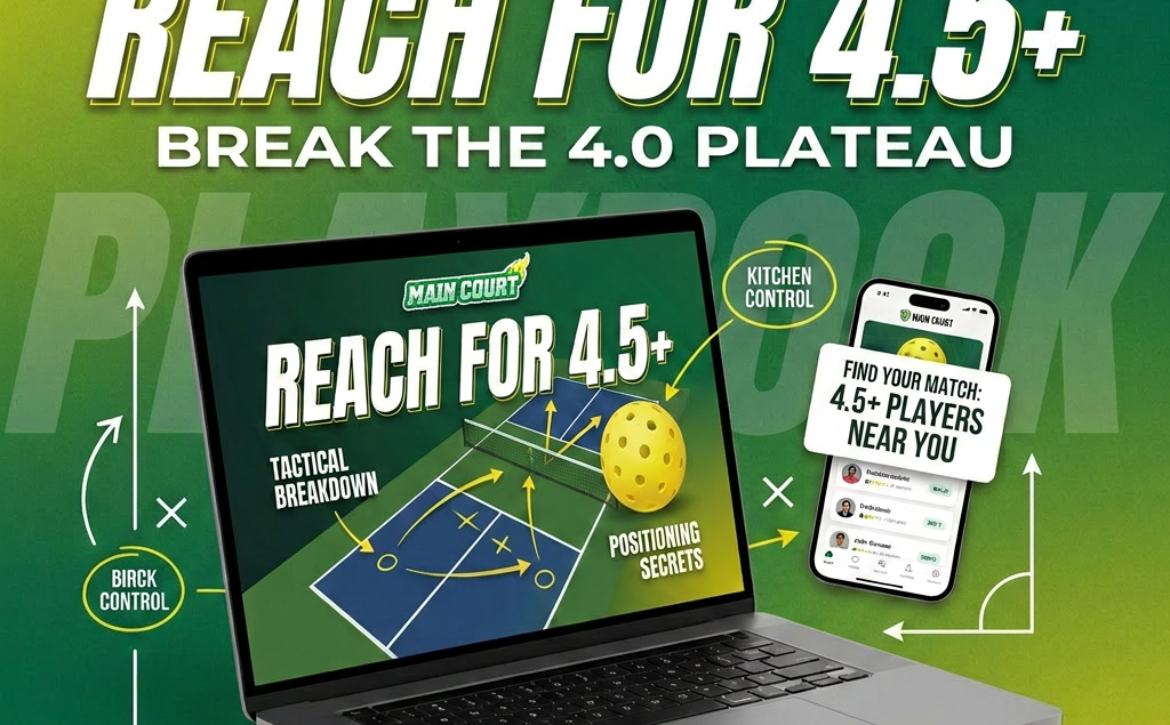
Almost every regular pickleball player hits the 4.0 pickleball plateau. From what we see across the Main Court community, the wall is rarely about technique — paddle skill at 4.0 looks broadly similar to paddle skill at 4.5. What changes is everything that happens between the shots: positioning instincts, shot selection, recovery habits, how you weight the next moment. Below are five recurring habit shifts we see in players who eventually break through, plus the part nobody talks about enough — how finding pickleball matches at your correct skill level is the single biggest accelerant for any of it.
1. Treat dinks like geometry, not artistry
At 4.0 most players’ dinks aren’t sloppy — they’re beautifully struck and landing in useless spots. Cross-court, only two zones genuinely pressure the other side: the wide back corner of their kitchen, and the back of their kitchen toward the centerline (right at their inside foot when they’re set). Everything in between is a soft pitch onto their forehand. Cycle between those two zones, accept that some attempts sail long, and stop feeding the backhand flick you’re about to get burned on.
2. Pattern recognition beats prediction every time
Watch a 4.5 rally and the players look like they’re reading minds. They aren’t. They’re running a mental lookup table of patterns they’ve seen hundreds of times and reacting fractionally faster than everyone else. Here’s one pattern you can bank tomorrow: a low flick aimed across an opponent’s body comes back to your same side roughly 90% of the time. So the higher-level player doesn’t guess — they pre-load. Weight shifts before the ball clears the net, paddle is already in the lane, the counter arrives exactly where they expected it to. The skill isn’t prediction. It’s a library, and the library only grows when you play opponents who haven’t already shown you their cards.
3. Floated a dink? Your next priority is positioning, not paddle
Every advanced player puts a dink in the air occasionally. The plateau habit is to brace stiff and prepare for “anything” coming back. Problem: anything isn’t equally likely. Against a right-handed opponent, the speedup through the middle seam is the highest-probability attack from a dead dink — by a margin that isn’t close. So default your paddle and your body into the middle. Cover the angle as the secondary read. Most stuck players obsess over reset technique and almost never train where they should be standing after a bad reset. Flip the ratio.
4. Pace at contact is doing all the work — not paddle face
This is the diagnosis plateaued players resist longest. They’ll tinker with grip, contact spot, paddle face angle, anything except the actual culprit — how fast the paddle is moving when it meets the ball. A dink only fails when it travels too far past the line, and that distance is governed by one variable: pace at contact. So when you’re stretched or scrambling, the right move is counterintuitive: swing slower, not harder. Decelerating reclaims depth, restores balance, and keeps you alive in the point instead of handing it over to a put-away.
5. Wide base for range, soft hands when the ball dips at your feet
Two habits combine here and you need both. First: a narrow stance is a hard cap on lateral range. You physically cannot shuffle wide from a stance that hasn’t pre-loaded the push, so reset into a wide athletic base between every point. Second: when the rally pulls you wide and a kicking ball is dipping at your shoelaces, do not hit topspin. The contact point is below kitchen-line height, topspin sends it long, and the other team rolls it back at your feet. A slice, cup dink, or soft block keeps you in the rally. Topspin into a low wide ball is how someone else’s highlight reel ends up with you in the background.
The part nobody talks about: finding pickleball matches at your correct skill level
Every plateau breakthrough we see follows the same shape. The player stops grinding mixed-level open plays and starts finding pickleball matches at their correct skill level. Here’s why that matters more than another paddle change or YouTube binge: playing exclusively against stronger opponents means you never close out points or test your reset under real pressure. Playing exclusively against weaker opponents means none of the five habits above ever get challenged. The sweet spot is consistent, level-matched competition — opponents half a step ahead or behind you, who force the decisions and reward the right ones. Playing at your correct skill level isn’t a small input. In our experience running the platform, it’s the single biggest factor separating pickleball players who climb from players who plateau — far outweighing technique tweaks, gear changes, or hours logged. If you don’t know where you actually sit on the 1.0–5.0 scale, take the free 3-minute skill assessment and then play the people the system surfaces. The compounding starts immediately.